
A hallmark is the oldest form of consumer protection in Britain: an independent guarantee that a piece is the precious metal it claims to be. Here’s the official notice every jeweller must display, how to read the marks, and why so many antique pieces are perfectly genuine without one.
The Dealer’s Notice
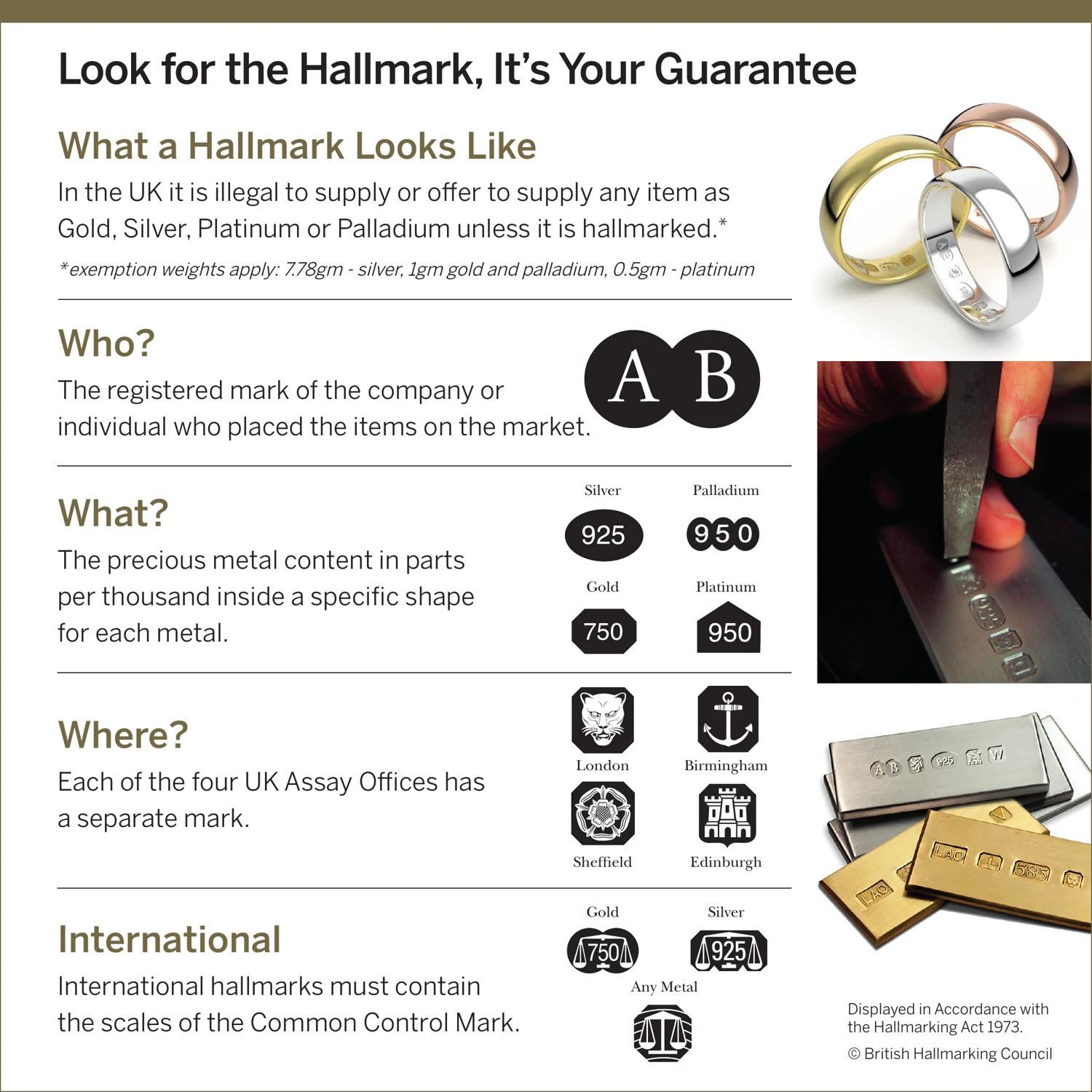
In the UK it is illegal to supply, or offer to supply, any item as gold, silver, platinum or palladium unless it is hallmarked, apart from the exemptions below. The British Hallmarking Council’s notice explains what a hallmark looks like, and we display it here as the Hallmarking Act 1973 requires.
Reading a hallmark
A full British hallmark is a small row of stamped marks, usually on the inside of a ring’s band, a clasp or the back of a brooch. Each tells you something different:
- Who
The sponsor’s mark
The registered initials of the maker, or of the company or person who sent the piece to be hallmarked, in a shield.
- What
The fineness mark
How much precious metal the piece contains, in parts per thousand, inside a shape that shows which metal it is.
- Where
The assay office mark
Which UK Assay Office tested and marked it: London’s leopard’s head, Birmingham’s anchor, Sheffield’s rose or Edinburgh’s castle.
- When
The date letter
Optional on modern pieces, but almost always present on older British ones: a letter, in a particular style and shield, for the year it was marked. It’s often how an antique piece is dated.
Pieces marked abroad may carry the Common Control Mark, a pair of scales around the fineness, which the UK recognises under an international convention.
Fineness marks
The number is the precious metal content in parts per thousand. These are the standards a UK hallmark can show; the familiar carat names are in brackets.
| Metal | Fineness |
|---|---|
| Gold | 375 (9ct) · 585 (14ct) · 750 (18ct) · 916 (22ct) · 990 · 999 |
| Silver | 800 · 925 (sterling) · 958 (Britannia) · 999 |
| Platinum | 850 · 900 · 950 · 999 |
| Palladium | 500 · 950 · 999 |
When a hallmark isn’t required
The law sets out a few exemptions. The two that matter most for jewellery:
- Very light pieces. Items under the exemption weights don’t need hallmarking: 1g for gold and palladium, 7.78g for silver and 0.5g for platinum.
- Pieces made before 1950. Items made before 1 January 1950, and not altered since, can be sold as gold, silver or platinum without a hallmark.
Antique and vintage pieces
Because so much of what we sell is antique or vintage, you’ll find pieces without a full hallmark, or without one at all. That doesn’t make them any less genuine, or any less legal to sell. There are good reasons a piece may be unmarked:
- It was never required. For long periods, many small or delicate pieces, such as rings set with stones, chains and earrings, weren’t compulsorily marked.
- It was made abroad, where marking rules were different or didn’t exist.
- The marks have worn away after a century or more of wear, especially on the inside of a ring.
- It has been resized or repaired, and the marked section of the band was removed along the way.
Every listing shows the marks a piece carries. If you’d like to know more about a particular piece, its marks, or how its metal was assessed, just ask and we’ll tell you everything we know.
Gold plating
Hard gold plating changes a piece’s colour, not its metal: a plated silver piece is still silver. On silver and gold the plating is no more than 2 microns thick at any point, the most the Hallmarking Act allows on a hallmarked piece without an assay office’s consent. Base-metal pieces are plated at 5 microns.
Questions
For more on hallmarking in general, the British Hallmarking Council and the UK’s four Assay Offices publish clear guides. For anything about one of our pieces, get in touch.